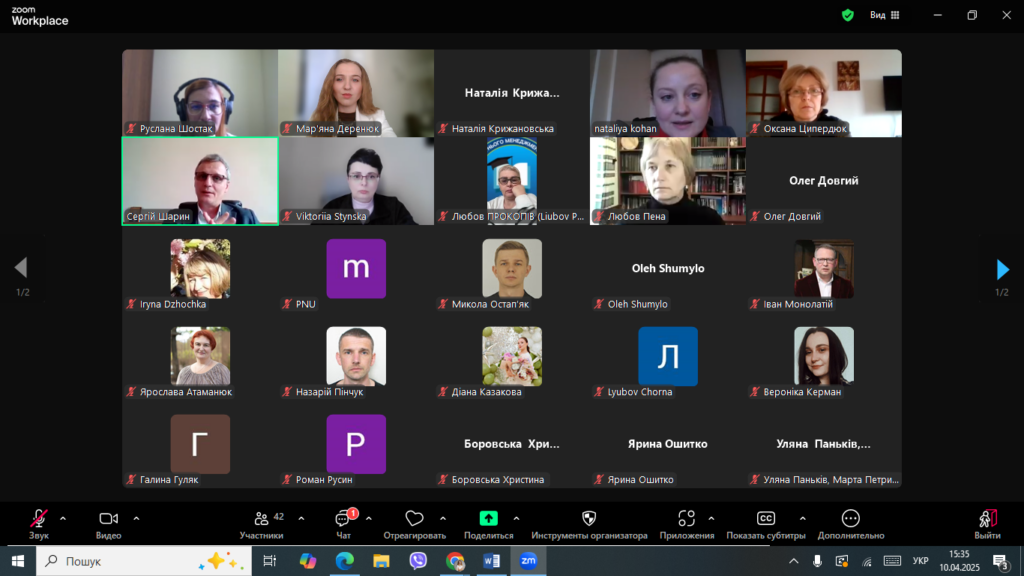
As part of the annual School of Academic Integrity, on April 10, 2025, an online webinar titled “Adhering to Corporate Ethics in the Online Environment” was held. The event provided a platform for discussing the challenges that modern society faces in the context of digitalization. It aimed to raise awareness among educators, students, and professionals about ethical standards for interaction in virtual environments, particularly within corporate culture and academic integrity.
The webinar opened with a welcoming address by Serhii Sharyn, Vice-Rector for Scientific and Pedagogical Work, who emphasized the importance of developing ethical standards in digital environments as an integral part of modern educational culture.
During the webinar, participants were introduced to a series of presentations covering current aspects of digital ethics and legal mechanisms for regulating online behavior.
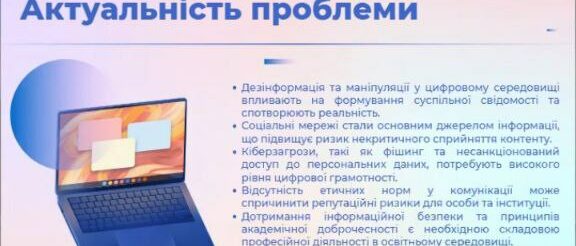
In particular, Mariana Dereniuk, PhD, Assistant at the Bohdan Stuparyk Department of Pedagogy and Educational Management, presented “Media Literacy and Information Security: How Not to Fall Victim to Manipulation on Social Media.” She highlighted the importance of critical thinking as a tool for protection against information influence, discussed modern methods for verifying information accuracy, and shared practical cases for identifying manipulative content.
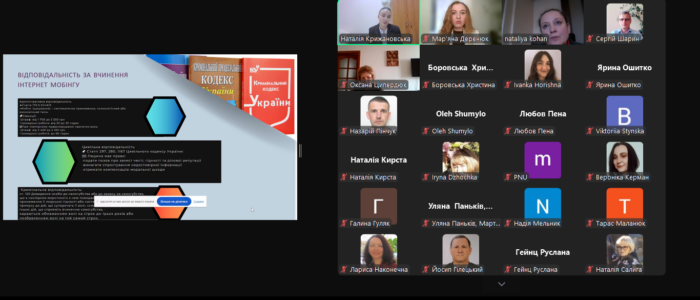
Nataliia Kryzhanovska, Specialist of the II Category at the Legal Clinic of NNUi, practicing lawyer, spoke on “Internet Mobbing — Real Responsibility for Virtual Offenses,” where she explained the legal grounds for accountability for aggressive online behavior. Her presentation included examples from court practice and an analysis of current legislation regulating user conduct in digital spaces.
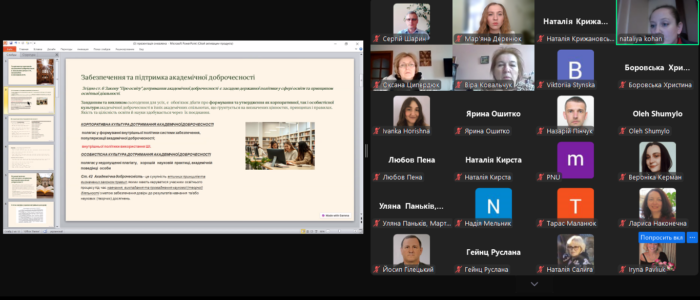
The final part of the webinar was presented by Nataliia Kokhan, Candidate of Legal Sciences, Associate Professor of Labor, Environmental, and Agrarian Law at NNUi, on “Principles of Academic Integrity in PNU Local Regulations. Academic Responsibility.” Her talk covered the normative foundations of academic integrity, ethical principles of conduct in academic settings, and mechanisms for responding to violations.
Participants not only gained new knowledge but also had the opportunity to discuss pressing issues of digital culture and security, share their experiences, and exchange best practices. This format contributes to the development of a critically thinking community capable of effectively responding to the challenges of the information age.