

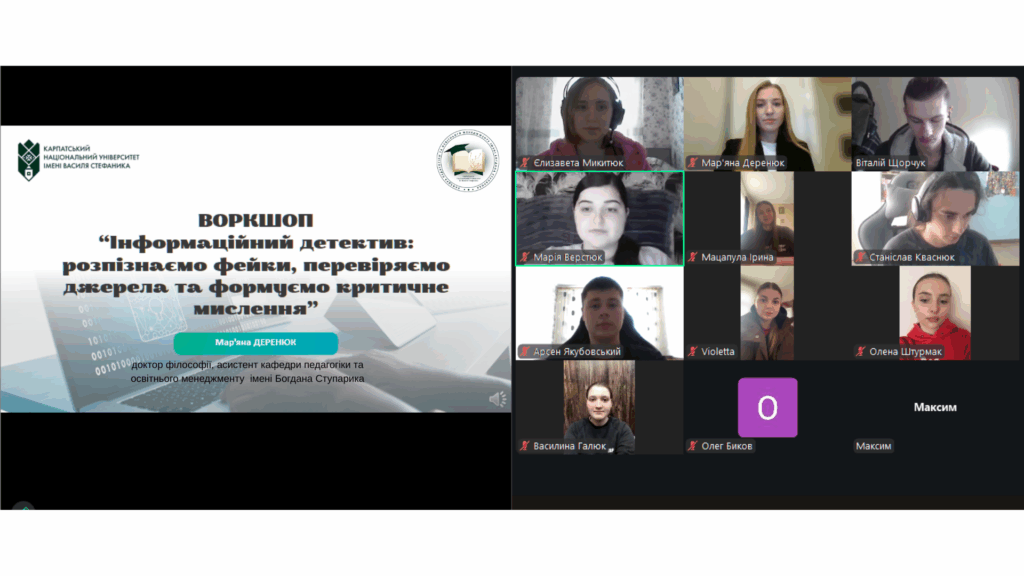
As part of Global Media and Information Literacy Week, Mariiana Dereniuk, curator of the second-year student group of the Educational and Professional Program “Vocational Education. Digital Technologies,” conducted a workshop titled “Information Detective: Recognizing Fakes, Verifying Sources, and Developing Critical Thinking.”
The workshop aimed to enhance students’ media literacy, develop critical thinking skills, and foster responsible information consumption in a digital society. The program was built around interactive tasks, digital tools, and practical case studies, supported by original web pages and online resources.
The first stage involved completing the National Media Literacy Test, which enabled each participant to assess their own level of information awareness and ability to recognize fake news. This was followed by a series of thematic modules:
-
“Screen–Screen Generation” – a discussion on the impact of the digital environment on young people’s thinking, the development of clip thinking, and attention in an era of constant screen presence.
-
“Fakes: Truth, Half-Truth, Manipulation” – an interactive exercise “Believe It or Not,” analysis of real and fabricated news examples, and identification of psychological triggers and manipulation mechanisms.
-
“Information vs. Propaganda” – a group task focused on recognizing key features of propaganda and creating associative concept maps.
-
“Clickbait and the Power of Headlines” – practical work comparing emotional and neutral headlines and identifying manipulative elements.
-
“My Digital Media Safety Checklist” – a creative task in which students formulated their own rules for responsible use of the information space.
Throughout the workshop, students worked in teams, engaged in discussions, analyzed media texts, completed online tests, and created interactive media safety recommendations. All stages were supported by multimedia materials, QR codes linking to tasks, and reflective discussions.
The event contributed to the development of students’ information culture, enhanced their ability to think critically, distinguish facts from opinions, and respond responsibly to media influences. Students noted that participation in the workshop helped them realize the importance of source verification, avoiding emotional traps, and building personal information resilience.
The workshop became another step in implementing a practice-oriented approach to training future vocational education professionals and demonstrated the effectiveness of interactive learning formats in developing media competencies of modern specialists.